Push, Don't Poll: A Tiny Claude Code Plugin
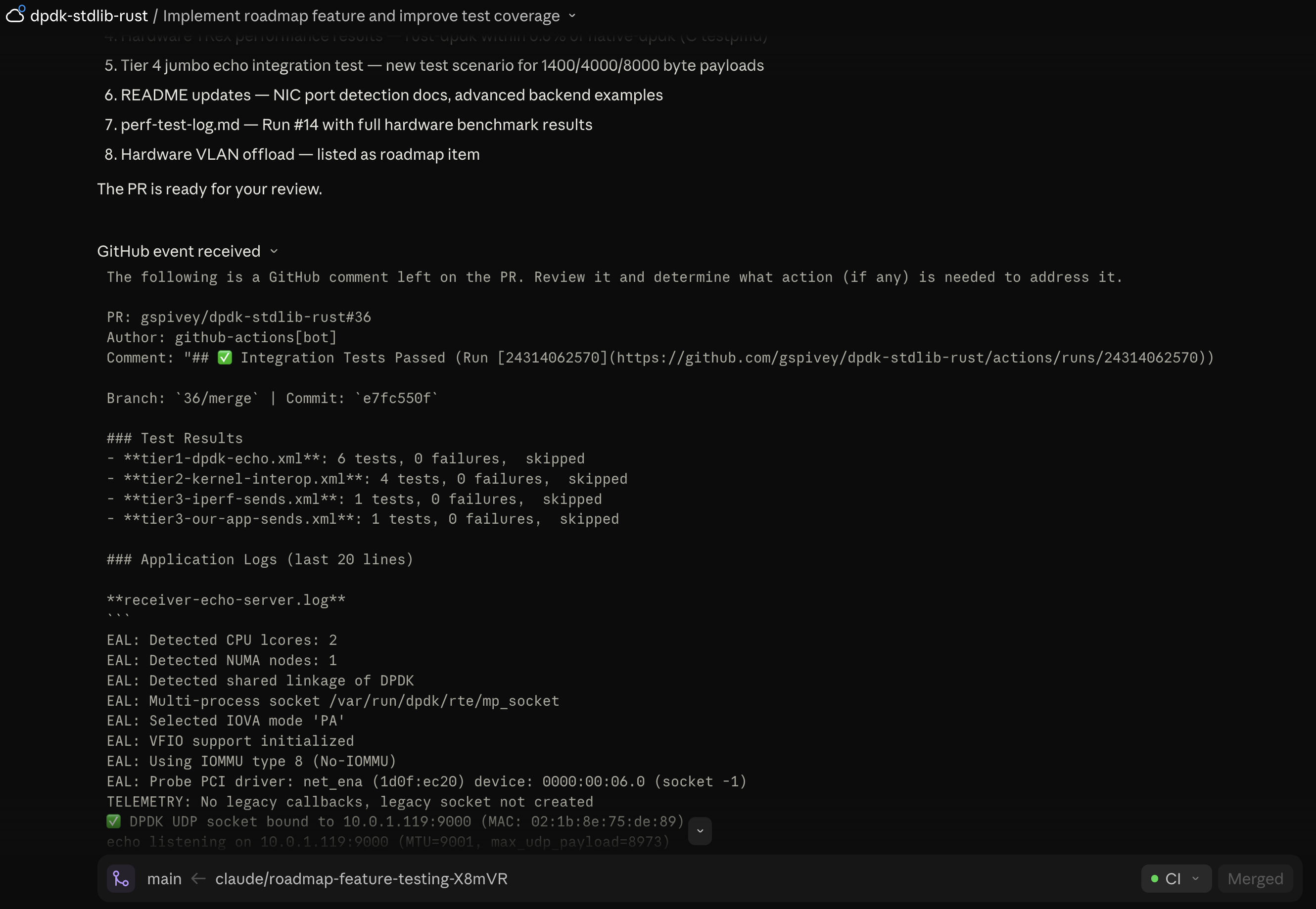
A concrete example of the harness pattern from Part 2. The Problem I kick off a Claude Code Web …

I’ve used AI in my work every day for four or five years. Around December 2025, it crossed a line for me. I could suddenly do work I never had time for before.
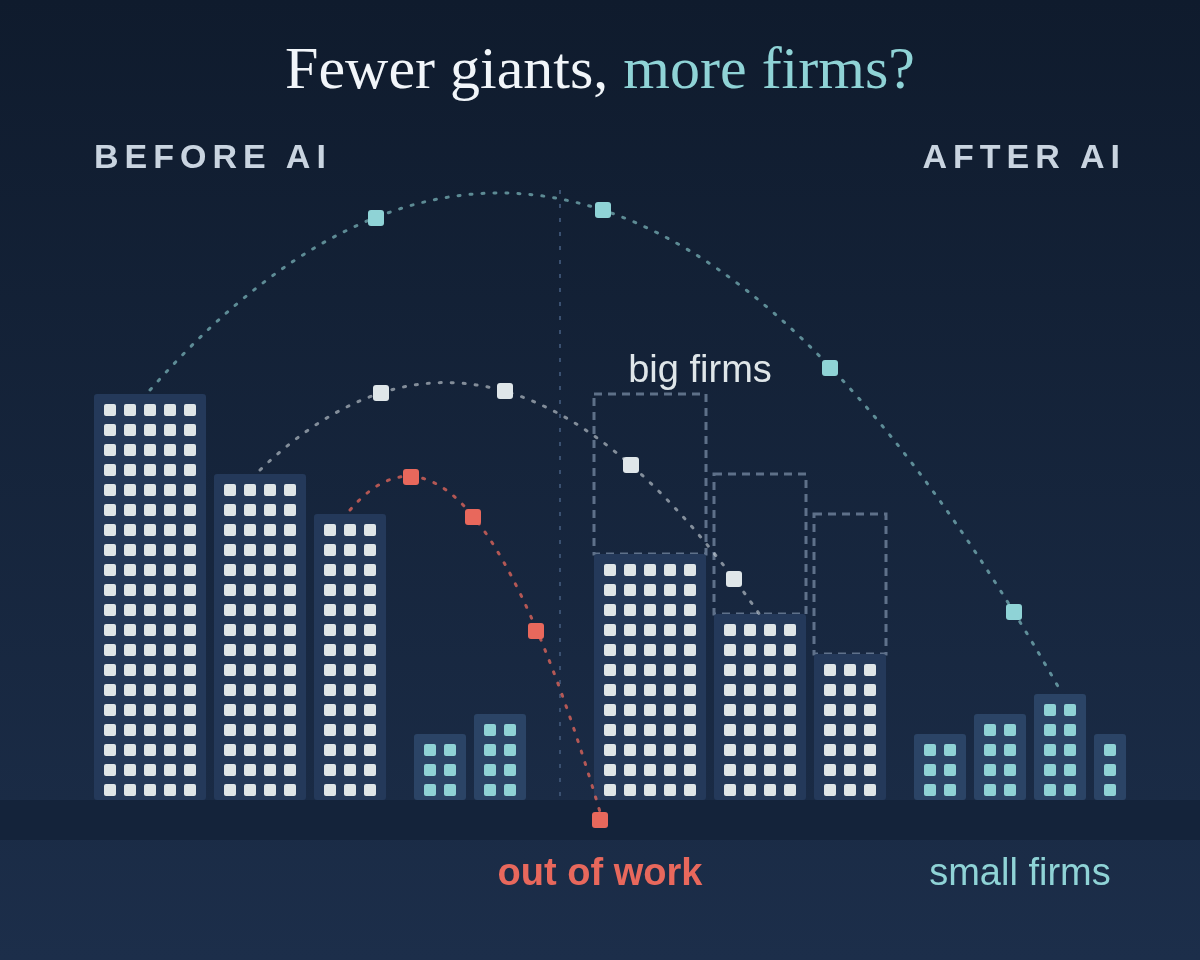
That got me wondering whether one person doing a team’s work means fewer jobs, or more companies. I spent the last few weeks testing it with a small model of an economy, Census data on new businesses and the newest research. What I learned: replacement isn’t the only possible outcome. New companies can make up for lost jobs, but only under certain conditions, and we can watch for those conditions in real data.
The first thing I did with my new capacity was start a project that had been bouncing around in my head for almost a decade: a Rust networking library built on DPDK. I’d first pictured it in Go years ago; this time I wanted to build it in Rust. My plan was to hand-write a UDP layer. I ended up with a TCP stack that runs in userspace, the kind of thing that usually takes a team of specialists years. I never imagined writing one.
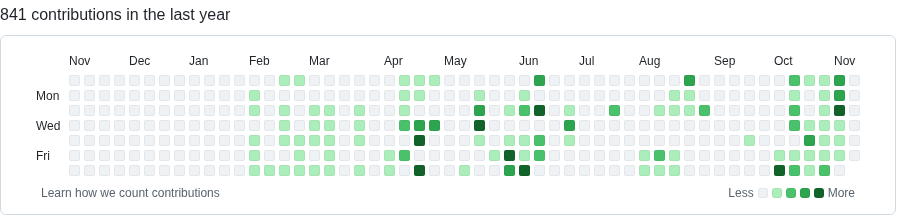
My GitHub tells the story. I made 841 public contributions in the last twelve months, against 65 in the ten-plus years before that, combined. The public activity starts in February 2026, a couple of months after things clicked.
The effort it takes to do more has dropped, and I feel it. Most of what I read about this is about replacement: companies adopt AI and need fewer people. I wanted to know if that’s the whole story.
When a company adopts AI, two things happen at once, and they pull in opposite directions.
If the second force wins, the company grows and hires, even though AI is doing part of the job. If the first force wins, it does the same work with fewer people.
My DPDK project is an example of the second force. AI let me take on far more work than I’d planned. Whether whole companies behave that way is the big open question.
AI also lowers the cost of starting a new company. You need fewer people to build a product, write the marketing and answer customers.
We’ve seen a version of this before. Cloud computing made starting a software company dramatically cheaper: no servers, no data center, just a credit card. Over those years, from 2006 to 2019, applications for new businesses rose 34%. Applications from people who planned to pay wages fell 48% (Census Business Formation Statistics).
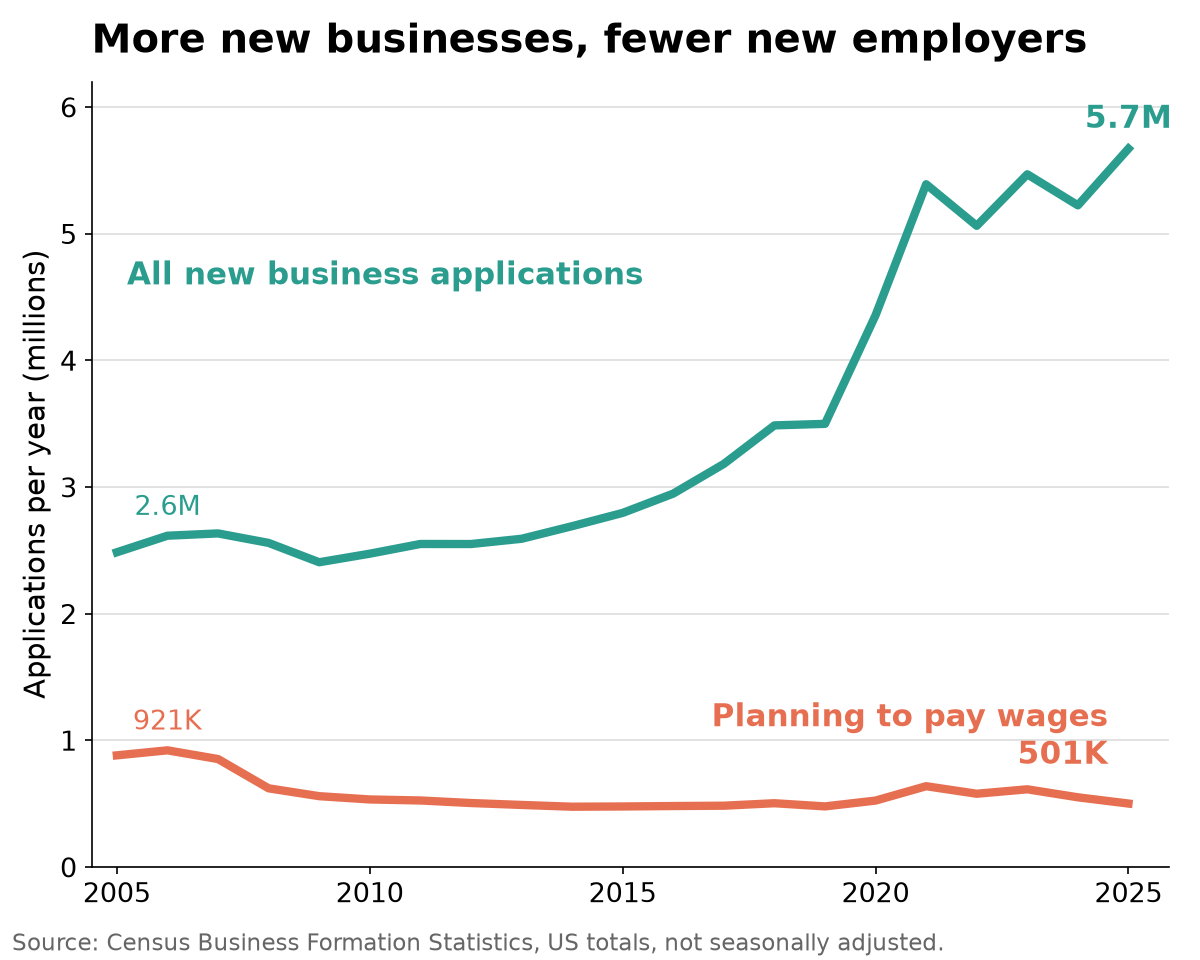
That doesn’t prove cloud caused either trend. But it’s a warning: more new businesses doesn’t automatically mean more new employers.
To test my idea, I built a simple simulated economy of about 175,000 workers. Companies are born, grow if they’re productive, shrink if they’re not, and close when they stop making money. Then I add AI.
Nobody knows how strong AI’s effects are, so I didn’t pick one guess. I ran the economy 2,000 times with different guesses. Each run has a twin with the same luck where AI never arrives, so I can see what AI changed.
Two lessons came out of that.
My first results were too optimistic. At first, AI added jobs in most of my runs. But in most of those runs, the big companies never shrank. They used AI to sell more and kept hiring, so there were no lost jobs to replace.
So I looked only at the runs where big companies did cut jobs. Did new companies hire enough to make up for it? In about 6 of every 10 runs, yes. When I also let the price of AI vary, that dropped to fewer than half. The answer kept moving with assumptions I couldn’t check, so I won’t give you odds. I’ll give you the conditions instead.
Three questions decide it:
In my model, new companies reliably made up the losses in two situations: when companies adopting AI grew instead of shrinking, or when AI-native startups were much more productive than the ones before them. They reliably failed to when AI replaced people easily and the new startups were no better. In between, the results were mixed, and they swung with my assumptions.
A model only tells you what to look for, so I went looking.
Lots of new businesses, very few new employers. Business applications are at a record, up 10.9% from January to October 2026 compared with the same months of 2025. Applications from people planning to pay wages are down 16.5%. Only 6.8% of this year’s applications plan to pay wages, and just 4.7% in the Information sector (Census Business Formation Statistics, November 2026 release).
Two of the most AI-exposed industries pulled ahead. Starting around March 2025, applications in Information and Professional Services pulled away from the rest of the economy. On average in 2026, they ran roughly a third higher, relative to other sectors, than in 2022. Most of that came from applications the Census Bureau rates as unlikely to hire.
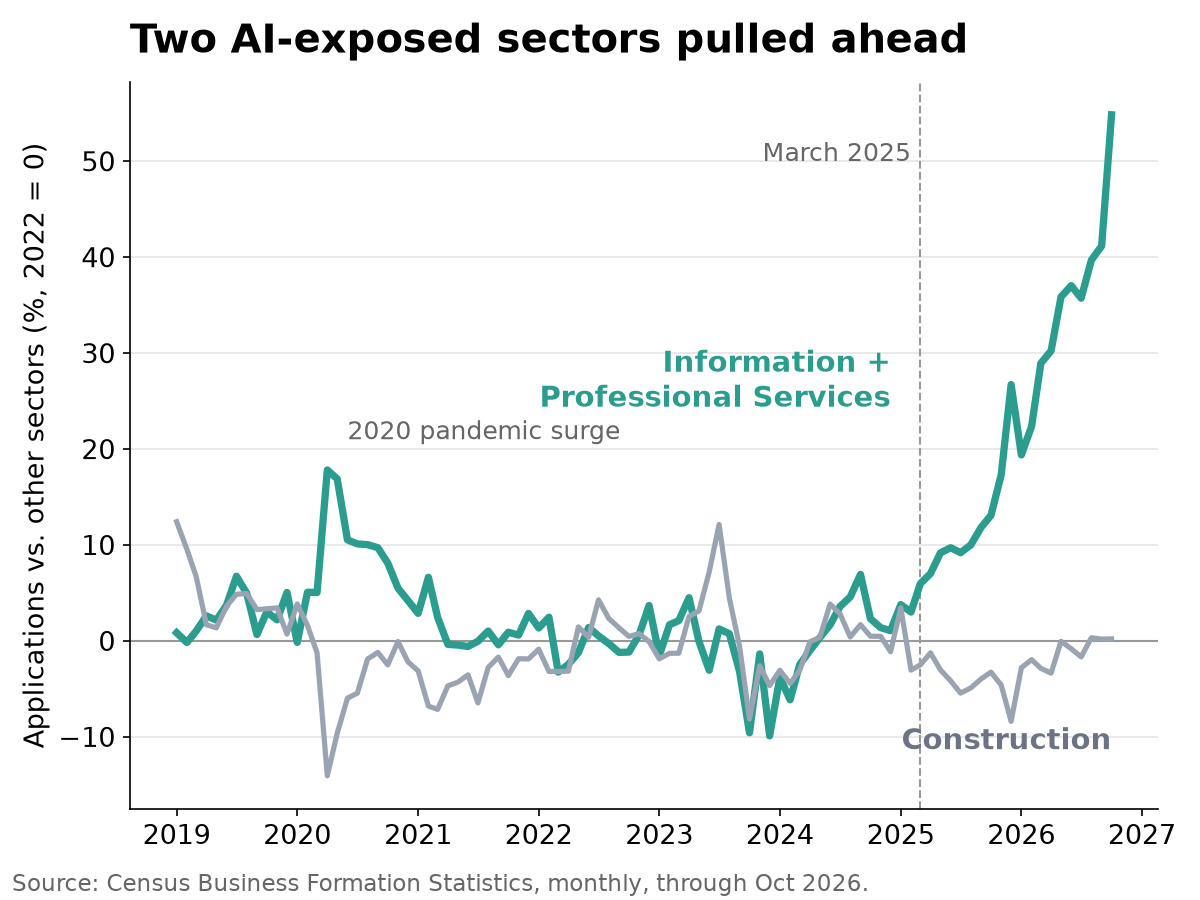
Not every exposed industry followed. Finance is also highly exposed to AI, and its applications fell relative to other sectors over the same period.
And there’s a less hopeful reading of the surge: laid-off tech workers registering as contractors. This data can’t tell the two stories apart.
Few companies are cutting because of AI, yet. In the Census Bureau’s Business Trends and Outlook Survey, fielded November 2025 to January 2026, about 2% of businesses using AI said they cut staff because of it (Bonney et al. 2026). The same study finds that companies using AI more deeply in their operations are more likely to see employment fall. It’s early.
AI-native startups are lean. They run 12–25% smaller than comparable startups (Kim and Koning 2026).
Two new studies look directly at this question, with much better data than mine:
Neither study looks at the biggest companies, which is where the largest cuts could come from. But both point the same way: more companies, smaller companies, and a fight over whether the jobs add up.
The surge in what look like solo ventures didn’t surprise me. It was validating. It’s exactly what I’d expect if people like me can suddenly do far more alone.
My bet is that many of those founders will hire once they make enough money. The odds I’m betting against are real, though. The Census Bureau projects that the roughly 500,000 business applications filed in October 2026 will produce about 28,000 new employers within a year (Census Business Formation Statistics, seasonally adjusted). That’s about one in eighteen.
The thing to watch is whether this wave of small new businesses beats that rate in the next few years.
I want to be clear about the limits.
More new businesses, almost certainly. Whether they add up to as many jobs is still open. It depends on whether companies that adopt AI grow, and on whether this wave of new, smaller companies starts hiring. The early data has some of each: lots of new businesses, very few new employers so far, and studies finding that new firms are filling some of the gap.
My own take: I don’t think replacement is the only possible future. The other one needs people willing to start small companies and willing to work at them. For anyone whose job is changing, and the studies above show that change can be painful, I think the best position is to be part of how your field changes rather than wait for it to happen to you.
Here’s what I’ll be watching:
| Signal | Where to find it | Good sign |
|---|---|---|
| Jobs at companies that adopt AI | Census Business Trends and Outlook Survey | The 2% stays low as AI spreads |
| Hiring at AI-native startups | Studies like Kim and Koning’s | Headcount grows with revenue |
| New employer businesses | Census Business Formation Statistics | Planned-wage applications start rising |
When those move, I’ll write the follow-up. If you want to see it, follow me on LinkedIn.
The model, the Census data and the code behind the charts are all on GitHub. A longer working paper is in progress.
This is a personal project, and the views here are my own, not my employer’s. I used AI tools to help build the model and edit this post.
A concrete example of the harness pattern from Part 2. The Problem I kick off a Claude Code Web …
Seven months later, the tools caught up to the vision. A Lot Has Changed When I wrote My …
How I turned trial‑and‑error into a repeatable workflow My experience with GenAI Here’s my take …